
Key Takeaways:
- A 1031 exchange allows you to sell an investment property and reinvest the profit into a new one to delay paying capital gains taxes.
- You must follow a strict timeline: 45 days to identify a new property and 180 days to close the deal.
- You cannot handle the funds yourself; you must hire a Qualified Intermediary to hold them to avoid disqualifying the tax break.
You just sold a rental property for a $200,000 profit. That sounds like a win until you look at the tax implications. Between federal capital gains, depreciation recapture, and state taxes, the IRS could take 20% to 30% of your earnings. That is money you cannot use to buy your next deal.
This is the investor’s dilemma. Selling unlocks profit, but it also triggers a massive bill.
The 1031 exchange is a government-sanctioned tool that allows you to defer those taxes and keep your full equity working for you. If you want to build a real estate portfolio that scales, you need to know how to swap properties without losing momentum.
We wrote this guide to explain exactly how it works, the strict timelines you must hit, and how to finance the next deal before the clock runs out.
What Is a 1031 Exchange?
In simple terms, a 1031 exchange allows you to sell one investment property and use the proceeds to buy another “like-kind” property. By doing this, you push the tax bill down the road.
You are not avoiding taxes forever; you are deferring them so you can use that capital to buy a bigger or better asset today.
The “Swap ‘Til You Drop” Strategy
Seasoned investors often use a strategy called “Swap ‘Til You Drop.” You keep exchanging properties throughout your lifetime. You might trade a duplex for a four-plex, then a four-plex for an apartment building.

When you eventually pass away, your heirs receive the property with a “step-up in basis.” This effectively wipes out the deferred capital gains tax history. It is one of the most powerful wealth-transfer tools available.
Scope: Investment Only
This tool is strictly for business or investment real estate. You cannot use it on your primary residence. It applies to rental homes, commercial buildings, and land.
If you need financing for these purchases, reviewing options for investment property loans is your first step to ensure the numbers make sense.
Pro Tip:
- Be careful with vacation rentals. To qualify for a 1031 exchange, you must strictly limit your personal use of the property (typically to 14 days per year or 10% of the days rented) for the first two years. If you treat it like a second home, the IRS may disqualify your tax savings.
How Does a 1031 Exchange Work? (The Timeline)
The IRS does not offer extensions for 1031 exchanges. The timeline is rigid. If you miss a deadline by one day, the exchange fails, and you owe the taxes.
Here is the calendar you must follow:
- Day 0: Close on the Relinquished Property. The clock starts the minute the escrow closes on the property you are selling.
- Day 45: The Identification Period. You must provide your Qualified Intermediary with a written list of potential replacement properties. You cannot change this list after Day 45.
- Day 180: The Exchange Period. You must close on the new property. This is 180 days from the sale of your old property, not 180 days from when you find the new one.
Pro Tip:
- Don’t wait until Day 1 to start looking. Seasoned investors often include a clause in the sale contract of their old property that extends the closing date if they haven’t found a replacement yet. This effectively buys you extra time before the official 45-day clock starts ticking.
The “Boot”
If you decide to keep some of the cash from the sale, perhaps $20,000 to buy a car or pay off personal debt, that money is called “boot.” The IRS taxes boot as income. To defer 100% of your taxes, you must reinvest 100% of the net proceeds.
1031 Exchange Requirements You Must Follow
The rules for a 1031 exchange property are specific. We see investors most often trip up on these three requirements.
1. The Qualified Intermediary (QI)
This is the most critical rule. You cannot touch the money. If the proceeds from your sale are deposited into your personal bank account, the exchange is void.
You must hire a Qualified Intermediary (QI) before you close on the sale. The money goes from Escrow A directly to the QI, and then from the QI to Escrow B.
2. Like-Kind Definition
“Like-kind” is broader than most people think. It does not mean you must swap one condo for another. It means you are swapping investment real estate for investment real estate.
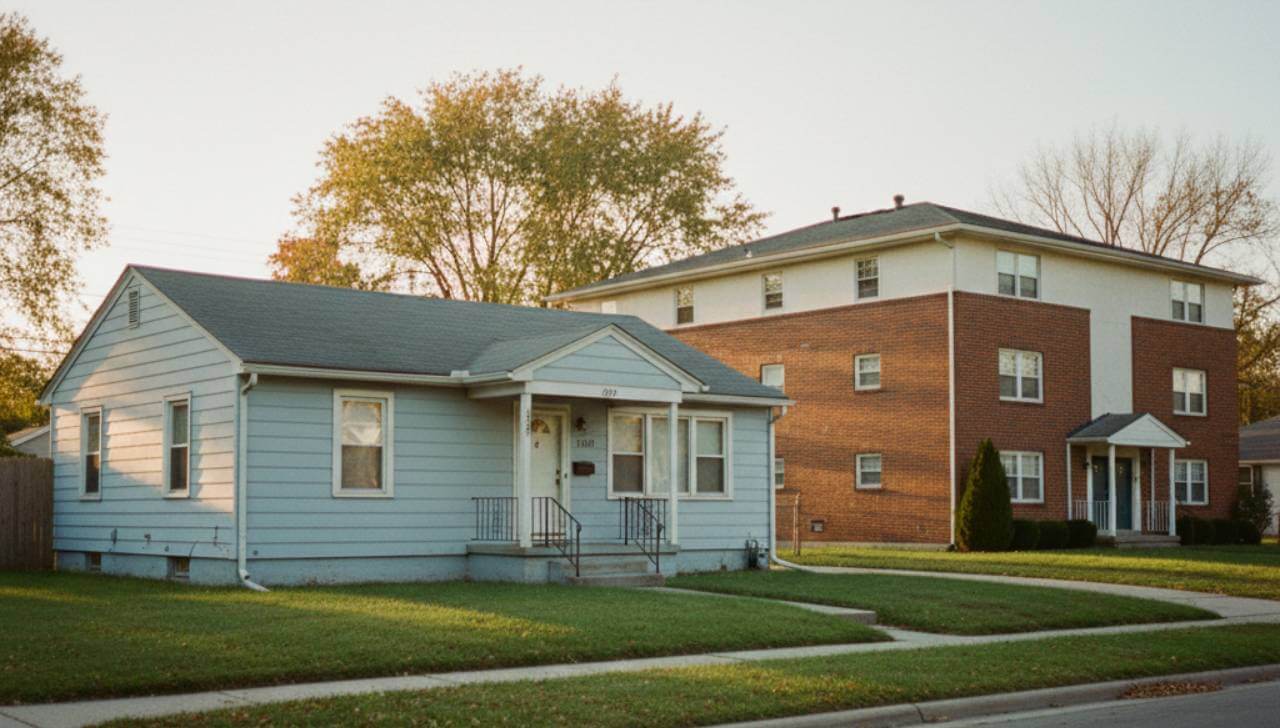
You can sell a warehouse and buy raw land. You can sell a single-family home vs. a multi-family home and trade up to a commercial strip mall.
3. Equal or Greater Value
To entirely defer tax, the new property must generally be of equal or greater value than the one you sold. You must also replace the debt.
If you sold a building for $1 million with a $600,000 loan, you usually need to buy a property for at least $1 million and carry at least $600,000 in debt. Alternatively, you can bring in fresh cash to cover the difference.
Are duplex properties on your radar? They are a typical “trade up” target for investors moving out of single-family rental.
Pro Tip:
- Don’t forget about closing costs. To defer all taxes, you generally need to reinvest the net proceeds. However, transaction costs (like agent commissions and title fees) on the buying side are usually considered valid exchange expenses, which can help you hit your reinvestment targets without needing extra cash.
1031 Exchange Loans: Financing Your Next Property
This is where the timeline often breaks. You have 180 days to close. If you are using a traditional bank loan, you are at the mercy of their underwriting speed.
Banks look at your personal tax returns, debt-to-income ratio, and pay stubs. That process can take 45 to 60 days or longer. If the bank delays, you miss your deadline and get hit with the tax bill.
The Solution: DSCR Loans
We often recommend DSCR loans for 1031 exchanges. These loans qualify based on the rental income of the new property, not your personal tax returns.
Because the underwriting is simpler, they can close faster than conventional loans.
Speed is your best friend during an exchange. Using no-document loans or investor-specific financing helps ensure you don’t run out of time while an underwriter asks for another W-2 from three years ago.
Pro Tip:
- Always have a financing contingency plan. If your appraisal on the new property comes in low, the bank will reduce the loan amount. Since your 1031 funds are locked with the Intermediary, you may need to liquidate cash from your own pocket to bridge the gap. We recommend keeping a cash reserve accessible just for this scenario.
1031 Exchange California Rules and Considerations
California investors face a unique set of rules. The state Franchise Tax Board (FTB) is aggressive about collecting what it is owed.
The Clawback Law
If you sell a property in California and use a 1031 exchange to buy a property in a tax-free state like Texas or Tennessee, California does not forget about you. You must file a specific form with the FTB every year to track that deferred gain.

If you eventually sell that out-of-state property for cash, California will come back to collect the taxes on the profit you initially made in California. This is often called the “clawback.”
Pro Tip:
- Digital records are your best friend here. Since the California “clawback” can happen decades later when you finally cash out, paper records often get lost. Scan your FTB form 3840 and your original closing statements into a cloud storage folder so you don’t end up paying double taxes due to lost paperwork 20 years from now.
High-Value Swaps
We see many clients selling high-value California real estate to buy multiple cheaper homes elsewhere. You might sell one house in Los Angeles for $1.5 million and buy five rentals in the Midwest. However, if you are trading one expensive property for another costly property, you may need jumbo loans to bridge the gap.
Pros and Cons of a Like-Kind Exchange
Is this the right move for you? Compare the benefits against the friction.
Pros:
- Defer Taxes: Keep 100% of your equity working for you.
- Buying Power: Use pre-tax dollars to purchase larger assets.
- Estate Planning: Potential for tax elimination for your heirs.
- Portfolio Adjustments: Shift from high-maintenance homes to low-maintenance commercial triple-net leases.
Cons:
- Strict Deadlines: The 45-day and 180-day rules are unforgiving.
- Fees: You must pay a Qualified Intermediary.
- Pressure to Buy: You might feel forced to buy a mediocre deal just to save on taxes.
- Limited Access to Cash: You cannot easily take cash out without paying tax on it (boot).
Step-by-Step: How to Execute a Successful Exchange
If you are ready to proceed, follow this checklist to keep the deal on the rails.
- Talk to a tax advisor. Confirm your capital gains liability, so you know exactly how much you are saving.
- Select a Qualified Intermediary. Do this before you list your property for sale.
- Get Pre-Approved. Do not wait until Day 1 to look for a loan. Contact us to secure financing so you can make strong offers immediately.
- Identify properties. You have 45 days. Aim to identify three solid options.
- Close the deal. Ensure your lender and title company know you are on a strict 180-day clock.
Leverage Your Equity, Keep Your Cash
A 1031 exchange is the most effective way to grow a real estate portfolio without suffering from tax leakage. Every dollar you send to the IRS is a dollar that isn’t earning you appreciation or rent.
The IRS sets the rules, but the success of the transaction usually depends on the financing. If your loan drags on, the exchange fails. At ID Mortgage, we specialize in helping investors meet these tight deadlines with financing products designed for speed.
FAQs
Can I live in a property bought with a 1031 exchange?
Not immediately. The property must be held for investment purposes. A common rule of thumb is to rent it out for at least two years before converting it to personal use. If you move in too soon, the IRS may disqualify your exchange.
What is the 45-day identification rule?
You must provide your Qualified Intermediary with a written list of potential properties you plan to buy within 45 days of selling your old one. You can identify up to three properties regardless of value, or more properties if they meet specific value caps.
Can I use a 1031 exchange to pay off debt?
No. You must reinvest all net equity into the new property. If you use proceeds to pay off credit cards or personal loans, that money is considered “boot” and is fully taxable.
What happens if I miss the 180-day deadline?
The exchange fails. Your Qualified Intermediary will release the funds to you, and the sale of your original property will be treated as a standard taxable sale. You will owe capital gains taxes for the tax year the sale occurred.
Do I need a specific type of lender for a 1031 exchange?
While not legally required, it is highly recommended. Lenders unfamiliar with investment deadlines can cause delays that kill the exchange. You need a broker who understands investor financing, DSCR options, and the urgency of the 180-day window.